Queen Elizabeth National Park is a savannah national park located in western region of Uganda. The park covers about 1,978 square kilometres. It stretches across the districts of Kasese, Rubirizi, Rukungiri and Kamwenge. The park was established in 1952 as Kazinga National Park. However, it was renamed two years later after the visit of Queen Elizabeth II. Today, it remains one of Uganda’s leading wildlife conservation areas. It is also managed by the Uganda Wildlife Authority.
Queen Elizabeth National Park sits between Lake George and Lake Edward. The Kazinga Channel connects these two lakes. In addition, the park lies at the base of the Rwenzori Mountains. This location creates a variety of landscapes and habitats.
Flora in Queen Elizabeth National Park
Queen Elizabeth National Park has one of the richest ecosystems in Uganda. The park covers grasslands, forests, wetlands, lakes and crater landscapes. As a result, it supports a wide variety of plants and animals.
The vegetation changes from one part of the park to another. Open savannah grasslands cover much of the northern and central areas. These grasslands provide food for grazing animals throughout the year. In contrast, acacia woodlands grow in drier parts of the park. Thick forests, including Maramagambo Forest and Kyambura Gorge, support many forest plants and animals. Papyrus swamps and wetlands also grow along rivers and lake shores.
Many tree species thrive in Queen Elizabeth National Park. Common trees include acacias, fig trees, euphorbias and candelabra trees. Shrubs, grasses, and flowering plants grow across the park. Together, these plants provide shelter, nesting areas and food for wildlife. They also help protect the soil and water sources.
Fauna in Queen Elizabeth
Queen Elizabeth National Park is home to more than 95 mammal species. Large animals include elephants, buffaloes, lions, leopards, and hippopotamuses. Uganda kobs, waterbucks, bushbucks and topis feed in the open grasslands. Warthogs and spotted hyenas are also common in many areas. Meanwhile, giant forest hogs live mainly in the forested sections.
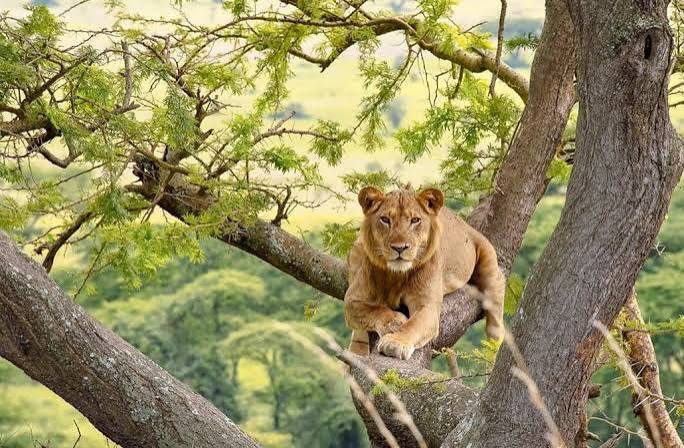
The park is famous for its tree-climbing lions in the Ishasha sector. These lions often rest in large fig trees during the day. Although the reason is not fully understood, this behaviour attracts many visitors. Leopards also live in the park but are harder to spot because they are mostly active at night.
Several primate species live in the forests and gorges. Chimpanzees are the main attraction in Kyambura Gorge. In addition, visitors may see black-and-white colobus monkeys, vervet monkeys, olive baboons and red-tailed monkeys.
Birdlife is another highlight of Queen Elizabeth National Park. More than 600 bird species have been recorded in the park. Therefore, it is one of Africa’s leading birdwatching destinations. Common birds include African fish eagles, grey crowned cranes, saddle-billed storks, pelicans, kingfishers and African skimmers. Flamingos also visit some of the crater lakes during certain seasons.
The Kazinga Channel supports many aquatic animals. Hippos spend much of the day in the water. Nile crocodiles rest along the banks or float near the shoreline. The channel also attracts elephants, buffaloes and many bird species that come to drink or feed.
Areas of Interest in the park
Lake George
The papyrus swamps of this Ramsar wetland spot are home to the semi-aquatic sitatunga antelope. One can see the elusive Shoebill plus other native birds on the lake.
Explosion Craters
The 72 huge round basins spread across the equator are evidence of the Albertine Rift’s bubbling volcanic past, and are a must-see for those with exact interest in the region’s attractive geological history.
The 27km drive between Kabatoro gate and Queen’s Pavilion takes in views of the massive craters, circular lakes, the Rift Valley escarpment and the Kazinga channel – all in front of the mighty backdrop of the Rwenzori Mountains.
Lake Katwe
One of the most prominent lookout points in Uganda is in the Katwe-Kabatoro community on Katwe Salt Lake where traditional salt mining has been practiced since the 16th century. The neighboring Lake Munyanyange is a bird sanctuary, as well as a migratory spot for the lesser flamingo from August to November.
Kasenyi Plains
The vast savannah of Kasenyi is the ideal setting for a classic African safari experience.This region of the park comprises of large herds of Uganda kob, tree climbing lions; warthogs, guinea fowl scuttle through the grassland; and huge dark elephants stride across the game drive tracks, providing dream photo chances for visitors.
Mweya Peninsula
Mweya is Queen’s focal point. It contains the Visitors Centre, a luxury lodge and restaurant, hostel, campsite, budget food options and the departure point for the Kazinga Channel launch trip – and is still jam-packed with birds and animals.
Its high position gives beautiful views of the Kazinga Channel and surrounding savanna, and its nearness to Kasenyi and the North Kazinga plains make it an ideal departure point for wildlife-filled game drives in the morning or evening.
Kazinga Channel

A cruise down the Kazinga channel is the most calming way to enjoy a wildlife safari in Queen. The banks are crowded with hippos, buffalos and water birds, along with caimans, monitor lizards, marabou storks, weaver birds and elegant pairs of fish eagles. Elephants walk along the banks – all you need to do is sit back with your camera or binoculars at the ready, and enjoy the incredible sight.
Kyambura Gorge
The Kyambura River flows through this thick “underground forest”, 100 meters below the Kichwamba escarpment.
The gorge is best known for its chimpanzees – some of which are habituated and can be tracked through the forest with trained UWA guides. While walking through the gorge, you may see other primates and some of the several birds found in the forest. The entrance to the gorge is also a pleasant location for a picnic.
Maramagambo Forest
This forest of home to primates, including chimpanzees, baboons and several monkey species, the forest is also alive with many birds including the rare Forest Flycatcher, White-naped Pigeon and the outstanding Rwenzori Turaco. One can also visit the ‘cormorant house’, a large tree that has been turned white by the birds that rest here at night.
The shady forest also conceals crater lakes and a “Bat Cave” with a specially constructed viewing room.
Ishasha Sector
This remote southern region usually gets fewer visitors than the north, but those who venture this far may be rewarded with sightings of Ishasha’s most well-known residents – the tree climbing lions – lying around in the branches while keeping a close eye on herds of Uganda kob. It is also home to many buffalo and elephants as well as the rare shoebill.
Ishasha is also a suitable region to pass through on the way to Bwindi Impenetrable National Park.
Activities in Queen Elizabeth National Park
Game drives
For a standard African safari experience, the trails through Kasenyi, the North Kazinga Plains and the Ishasha Sector offer practically guaranteed buffalo, antelope and elephant sightings, along with warthogs and baboons. Taking an experienced guide in the early morning or at dusk is the most successful way to track down a pride of lions, and maybe even the odd leopard.
Launch trips
The Kazinga Channel is an oasis for many of the interesting species that live in the park, and taking a boat tour along it gives visitors the opportunity to cruise just meters from hundreds of huge hippos and buffalos while elephants stay behind on the shoreline.
Birding
Classified as an imperative Birding Area (IBA) by Birding International, Queen’s great diversity of habitats mean it is home to over 600 species. This is the best of any East African national park, and an extraordinary number for such a small area. The park’s convergence of savanna and forest, linking to the expansive forests of the DR Congo allow visitors to spot East as well as Central African species.
Caves tour in Queen Elizabeth National Park
Tucked below the cool canopy of the Maramagambo Forest is the “Bat Cave”. The cave has a viewing room from which visitors can watch the resident bats and pythons. For a more artistic cave experience, how about a trip to the historic cave at Nyanz’ibiri community?
Chimp tracking
The Kyambura Gorge experience is more than finding out about chimpanzees in their natural surroundings: it trains visitors about the network of Kyambura Gorge’s atmospheric “underground” rainforest, including vegetation types; bird discovery and conduct; and chimp and monkey ecology.
Cultural encounters in Queen Elizabeth
See the vigorous dances of the Kikorongo Equator Cultural Performers; workers collect salt on Katwe Salt Lake; a traditional Banyaraguru hut; or an agricultural village – all conducted by those who know them best – local community members.
Hiking/Nature walks
Nature walks are one of the more lively ways to go around the landscapes and wildlife of Queen Elizabeth. Locations include the shady Maramagambo forest; Mweya Peninsula with its attractive views; and Ishasha River, where you may see a number of forest and savanna species as well as having a distinctive chances to get extremely close to hippos – on foot!
Wildlife research tours
For visitors who desire to get up close to wild African fauna, a research expedition is a satisfying adventure. This new and exceptional experience allows visitors to eagerly participate in monitoring some of the exotic birds and mammals that fill the park, using locator devices and learn habituation calls, as well as monitoring weather, environment and conduct.