


Bwindi Impenetrable National Park is located in southwestern Uganda on the edge of the Albertine Rift Valley. Its mist-covered hillsides are covered by one of Uganda’s oldest and most biologically varied rainforests which have existed for more than 25,000 years, dating back to the Pleistocene period. The park lies at an altitude of between 1,160 and 2,607 metres above sea level creating a range of habitats for many plant and animal species.
Bwindi is widely known as Uganda’s leading destination for gorilla trekking. The forest protects the largest population of mountain gorillas in the world making it one of the conservation areas for this endangered species. The park receives an average of about 1,500 millimetres of rainfall each year which helps maintain its thick rainforest. It is also an important water catchment area with five major rivers originating from the forest before flowing into Lake Albert.
Around 500 years ago, before farming communities expanded into the region, Bwindi formed part of a much larger forest that extended southwards to the slopes of the Virunga Mountains. Although much of that forest has since disappeared, Bwindi remains one of the oldest and best-preserved tropical forests in Africa.
This biologically varied region also offers refuge to a further 120 mammals including several primate species such as baboons and chimpanzees, as well as elephants and antelopes. There are around 350 species of birds hosted in this forest, including 23 Albertine Rift endemics.
Flora of Bwindi Impenetrable National Park
The forest in Bwindi Impenetrable National Park is one of the oldest surviving tropical rainforests in Africa. It has existed for thousands of years and contains a mixture of lowland and montane forest vegetation. This combination allows many different plant species to grow within the park.
More than 1,000 plant species have been recorded in the park, including hundreds of tree species, shrubs, herbs, ferns, vines and flowering plants. Large hardwood trees form a thick forest canopy while bamboo grows in some parts of the park especially at higher elevations. Beneath the canopy are dense undergrowth, mosses, climbing plants and wild orchids that thrive in the cool, moist conditions. The forest also contains many medicinal plants that have traditionally been used by nearby communities for generations.
Fauna of Bwindi Impenetrable National Park
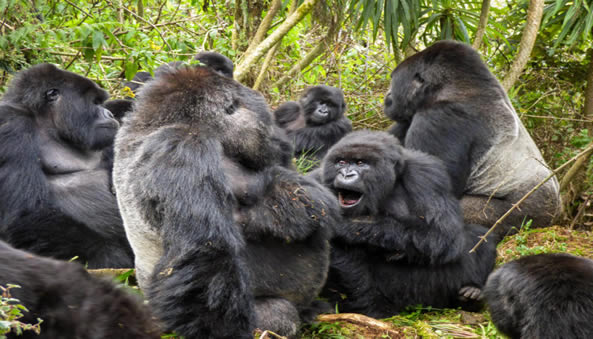
Bwindi Impenetrable National Park is known for its population of mountain gorillas. The park is home to the largest number of these endangered primates in the world. Several habituated gorilla families can be visited through guided gorilla trekking experiences.
Besides mountain gorillas, the park supports many other mammals. These include chimpanzees, black-and-white colobus monkeys, L’Hoest’s monkeys, blue monkeys, red-tailed monkeys, olive baboons and vervet monkeys. Smaller mammals such as duikers, bush pigs, giant forest hogs, bushbucks, African golden cats, African civets and several species of bats also live within the forest.
Birdlife is another highlight of Bwindi Impenetrable National Park. More than 350 bird species have been recorded making it a best spot for Uganda birding safari. Many of these birds are found only in the Albertine Rift region. Some of the species include the African green broadbill, Shelley’s crimsonwing, Grauer’s warbler, Rwenzori turaco handsome francolin and the black bee-eater.
The park is also home to many reptiles and amphibians. Chameleons, forest snakes, lizards, frogs and toads inhabit different parts of the forest particularly around streams and wetlands. In addition, thousands of insects, including butterflies, moths, bees, beetles and ants contribute to pollination and help maintain the health of the forest. More than 200 butterfly species have been identified in the park.
Sectors in Bwindi Impenetrable forest national park
Buhoma
Buhoma is positioned to the northwest of the park and faces the dark, hilly forests of Bwindi. Three gorilla groups can be tracked from here, and there are also community-run village walks for learning about the culture and lifestyle of the local Bakiga and Batwa tribes. Bird watching is also a main activity with great chances to see a number of Albertine Rift endemics such as the Short-tailed Warbler. Other activities include mountain biking and nature walks to waterfalls and parts of the forest. There are also several accommodations to suit all budgets and many local craft stalls.
Nkuringo
Located the southern edge of the park, became Bwindi’s second gorilla tracking trailhead in 2004. Tracking the Nkuringo groups is exhausting, for their forest home lies a full 600m below the trailhead at Ntungamo village on Nteko ridge. Walks along the ridge-top road offer terrific views north towards the forested hills of Bwindi and south to the Virunga volcanoes. There are also chances of discovering the Bakiga culture through village walks, lively dance performances and cultural workshops organized by community groups.
Rushaga
Shongi trailhead, in the southeast of the park opened for gorilla tourism in 2009. Three groups (Shongi, Mishaya and Kahungye) can be tracked from this point. The trail goes down into the depths of the forest directly to the south of the park. In addition, this area offers village walks, bird watching and a stunning waterfall.
Ruhija
Located via the eastern side, sitting on top of the hill at 2,345m, Ruhija is a habitat to the Bitukura, Oruzoojo and Kyaguriro gorilla groups. This is Uganda’s highest tracking trail, and one of only two areas (the other being Rushaga) where elephants live.
A six-hour bamboo trail leads to Rwamunyoni Peak; at 2,607m, it is the top most point in the park and famous for good birding. Also of interest to birders is the three-hour trail downwards to Mubwindi swamp along which one could find the endemic and localized African Green Broadbill.
Nyundo
This community, a short drive north of Buhoma, sits on the DR Congo border and offers splendid guided hikes along the hill crests and rivers to discover waterfalls, glorious views, and the traditional lifestyle and folklore of the Kigezi people.
Activities in Bwindi Impenetrable National Park
Gorilla tracking
It is an overwhelming experience to stand just meters from man’s far-away cousins as they eat, rest, play and connect with their young. Follow the mountain gorillas as they range freely in the impenetrable forest, and discover their attractive natural habitat and the many species they share it with.
Birding
The diverse homes of Uganda’s oldest forest mean it is the perfect home for a variety of birds, with 350 species recorded, including 23 endemics (90% of all Albertine Rift endemics) such as the Short-tailed Warbler and Blue-headed Sunbird as well as seven IUCN red data listed species.
Culture encounters
Discover the culture of the local Bakiga and Batwa communities with village walks, blacksmith visits, craft shops and lively dances – all against the amazing backdrop of the forest-covered hills of Bwindi.
Cycling or mountain biking in Bwindi
Mountain biking follows a well-maintained path from the park headquarters at Buhoma to the Ivi River. Along this 13kmpath you may see wildlife such as bushbucks, black-and-white Colobus and red-tailed monkeys.
Hiking or nature walks
There are six main nature tracks in Buhoma for those who wish to explore the “impenetrable forest”, including waterfall walks, forest strolls, primate encounters, mountain views and exciting birdlife.