

Gorilla trekking is a guided forest walk where visitors search for habituated mountain gorillas and spend time observing them in their natural habitat. It is carried out in Uganda, Rwanda and the Democratic Republic of Congo where the remaining wild mountain gorillas live.
In Uganda, gorilla trekking takes place in Bwindi Impenetrable National Park and Mgahinga Gorilla National Park. The activity supports the protection of mountain gorillas, their forest habitat and communities living near the parks.

Where is Gorilla trekking done
Mountain gorillas are found in only two areas in the wild. One population lives in the Virunga Massif which covers parts of Uganda, Rwanda and the Democratic Republic of Congo. The other population lives in the Bwindi-Sarambwe ecosystem of Uganda and the Democratic Republic of Congo.
Uganda has two parks where tourists can trek gorillas. These are Bwindi Impenetrable National Park and Mgahinga Gorilla National Park. Bwindi has four main trekking areas which includes Buhoma, Ruhija, Rushaga and Nkuringo. Mgahinga is located in Kisoro District and forms part of the wider Virunga ecosystem. In Rwanda, gorilla trekking is done in Volcanoes National Park whereas in DR.Congo it is done in Virunga National park for mountain gorillas and Kahuzi Biega for Eastern lowland gorillas.
How Gorilla trekking is carried out
Gorilla trekking normally starts in the morning with a briefing from park staff. Visitors are divided into small groups and assigned a gorilla family to track. Guides and trackers lead the visitors into the forest. Trackers look for signs left by the gorillas such as feeding areas, broken vegetation and nests. They use information from the previous day to help locate the group’s general area.
The length of the trek depends on where the gorillas have moved. Some groups may be found after a short walk while others require several hours of hiking through steep and thick forest. Once the gorillas are found, visitors observe them from the required distance and follow the instructions of the guides. In all countries, standard gorilla tracking allows visitors to spend one hour with the gorilla group. The forest can be wet, muddy and steep so visitors need reasonable fitness and suitable clothing.
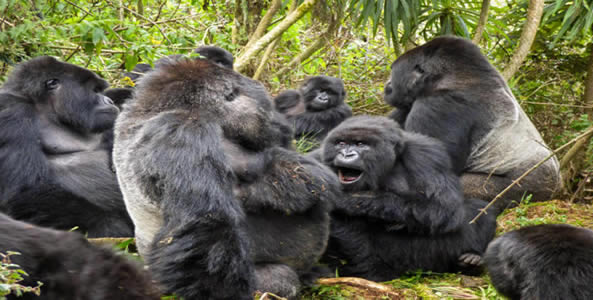
How many mountain gorillas are in the wild
The last completed combined population estimate recorded 1,063 mountain gorillas. This figure came from the 2015 census of the Virunga Massif and the 2018 census of the Bwindi-Sarambwe ecosystem. A new census of the Bwindi-Sarambwe population was launched in 2025 to provide an updated figure. The results were still being analysed according to Uganda Wildlife Authority’s 2026 wildlife report.
Mountain gorilla numbers have increased over the years because of continued protection, veterinary care, research, monitoring and community conservation programmes. Despite this progress, mountain gorillas remain an endangered subspecies.
What makes mountain gorillas special
Mountain gorillas are a subspecies of the eastern gorilla known scientifically as Gorilla beringei beringei. Their natural range is very small with populations found only in the Virunga Massif and the Bwindi-Sarambwe ecosystem.
They live in high-altitude forests and move through different vegetation zones in search of food. Mountain gorillas also live in social groups made up of a dominant silverback, adult females, younger males and young gorillas. Their close biological relationship with humans is one reason disease prevention is important. Human respiratory infections and other illnesses can affect gorillas making responsible tourism necessary.
How to get a gorilla permit

Anyone who wants to take part in gorilla trekking in Uganda must have a valid gorilla permit. Foreign non-residents normally obtain their permits through a Uganda Tourism Board-licensed tour operator. Other categories of visitors may purchase permits through procedures set by the Uganda Wildlife Authority.
The first step is to choose a trekking date and location. The tour operator can then check permit availability and arrange the booking with UWA. Travellers should make sure that payments are made through recognised channels. UWA advises visitors to obtain an official invoice before making payment and warns against paying unofficial individuals.
Because the number of visitors allowed to each gorilla group is limited, booking early is recommended.
How much does a gorilla permit cost
Gorilla permit prices depend on the visitor’s nationality and the applicable tariffs. Under the UWA tariff, the standard permit for a foreign non-resident costs USD 800 per person. Foreign residents pay USD 700, other African nationals pay $ 500 while East African Community citizens pay UGX 300,000. Gorilla habituation experience costs between $1500 and $ 1800. The experience allows visitors, accompanied by researchers to spend four hours with a gorilla family.
UWA also introduced lower rates for selected low season months. Foreign non-residents can pay USD 600 during April, May and November under the applicable low season arrangement.
Permit prices can change when UWA introduces a new tariff so travellers should confirm the current rate before booking.
Under the Rwanda Development Board, permits for international visitors cost $1500, foreign residents and African citizens pay $500 whereas East African communities including Rwandan Nationals pay $200. During the low season, permits are put on a promotional discount of 30% ($1050) between the months of November and May. However, this requires visitors staying at least 2 nights in either Nyungwe or Akagera National Parks.
In DR.Congo the gorilla trekking permits cost $400 per person, per trek for both mountain gorillas and lowland gorillas. For lowland gorilla habituation experience costs $500. Discounted rates apply for Congolese and regional citizens. The gorilla permit fees do not cover accommodation, transport, tips and porter fees.
Gorilla Trekking Rules
Gorilla trekking has strict rules because the animals are wild and vulnerable to human diseases. Visitors should follow the gorilla trekking rules and guidelines which include;
Keep the required distance from the gorillas.
Follow instructions from guides and rangers.
Avoid trekking if they have an infectious illness.
Avoid touching the gorillas.
Do not eat or drink while near the gorillas.
Do not smoke around the animals.
Do not use flash photography.
Do not leave rubbish in the forest.
Avoid sudden movements and loud noises.
Remain with the authorised trekking group.
Dispose of human waste according to park guidelines.
In Uganda, Rwanda and DR.Congo, a maximum of eight visitors can visit a gorilla group during standard tracking. The minimum age for gorilla trekking is 15 years. These rules help reduce stress, disturbance and disease risks for the gorillas.

Best Time for Gorilla Trekking
Gorilla trekking is available throughout the year. However, June to August and December to February are generally preferred because the trails are often easier to walk during the drier periods. The wetter months can make trails muddy and slippery. These months can still be suitable for trekking but visitors need proper waterproof clothing and shoes. Rain can occur at any time because Bwindi and Mgahinga are high-altitude forest areas. A dry season visit does not guarantee dry weather throughout the trek.
What to pack for gorilla trekking
A good packing list can make the trek easier. Visitors should consider carrying
Sturdy hiking boots
Long trousers
Long-sleeved shirts
Waterproof jacket or poncho
Gardening or hiking gloves
Warm clothing
Hat or cap
Insect repellent
Reusable water bottle
Small backpack
Camera and spare batteries
Gaiters
Personal medication
Walking stick if required
A pair of good hiking boots is especially useful because some trails are steep, muddy and uneven. Visitors can also hire a porter to carry their bags and assist on difficult sections of the trail. Porters are usually recruited from communities around the parks.